# Exponential Fellowship — Full content
Site: https://www.goexponential.org
# Our talent needs you.
Source: https://www.goexponential.org/host-startups
Work with and foster the next generation of exponential talent. Become a host for the Exponential Fellowship.
## Start the spark.
We care about progress. We believe that a few exponential people can change the trajectory of societies in incredible ways.
Our mission is to find them and kick-start their natural abilities by placing them in extraordinary experiences early in their careers. Our thesis is that high-growth, early-stage startups are ideal environments to ignite that spark.
**We want you to be that experience.**
---
## Host the Best
We've been privileged to build and work with some of the best teams in the Spanish startup scene. Like for our companies, we look for courageous builders with a will to serve, because we believe that's what it takes to create exponential organizations. So, that's what we bring to you.
---
# Exponential Manifesto
Source: https://www.goexponential.org/manifesto
Welcome. This is the heart of the Fellowship. It's where you can learn about what we do, and why we do it. This is what we believe in, and we hope you believe too.
## The Thesis
_"At critical moments in time, you can raise the aspirations of other people significantly, especially when they are relatively young, simply by suggesting they do something better or more ambitious than what they might have in mind. It costs you relatively little to do this, but the benefit to them, and to the broader world, may be enormous."_
– Tyler Cowen
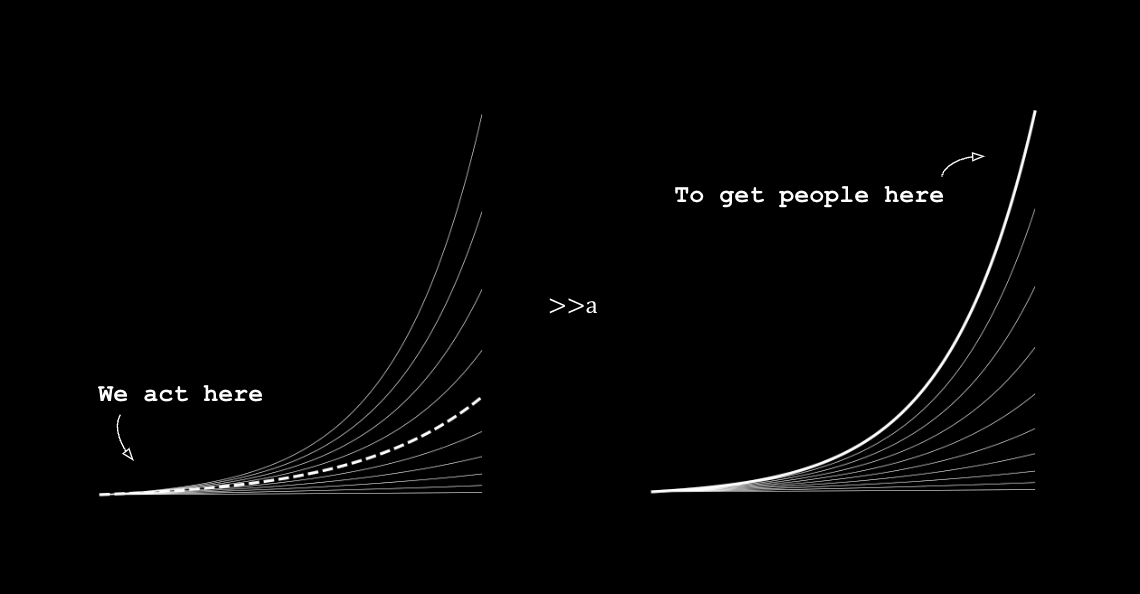
 In this function, two things matter most: the rate at which we apply the change (𝑎), and for how long (𝑥). What’s powerful is that small variations early in time are magnified for much larger returns down the line. That’s the magic of compounding.
 Another exponential phenomenon is [Human progress](https://x.com/0xgaut/status/1704523850422071335?s=20) – now so more than ever. **How do we increase the growth rate (𝑎) of progress?** Our thesis is simple: the machinery of an exponential society are exponential people who’ve been nurtured by exponential experiences. We believe that if we put **extraordinary people** in **extraordinary places**, they will go on to do **extraordinary things**.
Our mission is to find these people in the early onset of their careers, so we can accelerate their path to outsized returns for society. Because of the exponential nature of these individuals, a small but transformational experience today can benefit them – and the world – in ways we cannot imagine.
This is where it (hopefully!) gets interesting, so let’s dive in a little more detail.
## An Exponential World
History began 7 millennia ago, when we started writing _information_. At the core of progress is how we generate, access and share information. This is because the only way to leverage _expertise_ to innovate is to consume information. Just one or two generations ago, we only had access to information stored in books. Accessing that information was limited and slow, and updating information was tough. Big human milestones were achieved by bringing together groups of experts who’d spent years building intuitions on different subjects by piecing together information fragmented across thousands of pages of paper and ink.
The Information Age brought a revolution: software and the internet enabled anyone to access any piece of human knowledge instantly. Communities of experts were no longer bounded by geography. The internet became a [primordial soup](https://en.wikipedia.org/wiki/Primordial_soup) of easy-access expertise, perfect for compounding effects. And so, over the past 30 yearswe’ve experienced our own little [Cambrian explosion](https://www.britannica.com/science/Cambrian-explosion#:~:text=Cambrian%20explosion%2C%20the%20unparalleled%20emergence,make%20up%20modern%20animal%20life) of progress driven largely by **software**. [Software](https://a16z.com/why-software-is-eating-the-world/) is the tool that we are using to store, share and access information at an unprecedented rate. But, things are changing.
We now enter a new Era, powered by recent advances, particularly in AI and large language models. These technologies change the way we interact with information. If in the Information Age, one could become an expert faster than ever by accessing fragmented pieces of knowledge scattered across the web, in this new age the software _**is**_ the expert. It can generate new information by piecing together compounded human knowledge. In this new paradigm, a single individual can leverage thousands of years of collective human experience with a simple, natural language query on a piece of software. We are approaching the **Exponential Era.**
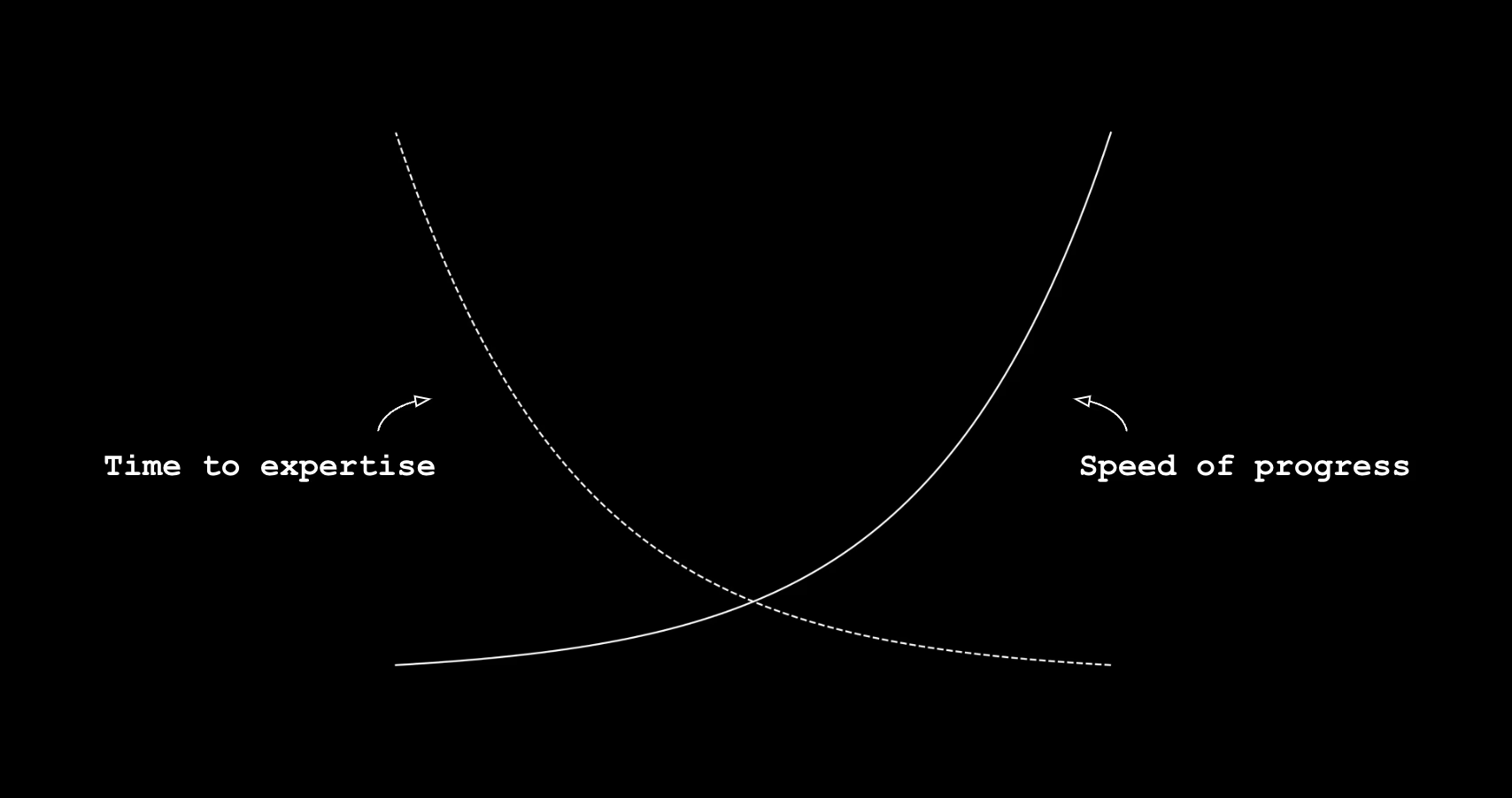 And here is an exciting (or scary?) thought: these technologies are today the most expensive and least powerful that they will ever be. People, organizations and nations that learn to leverage them will experience enormous growth. They’ll increase the steepness (𝑎) of their exponential curves, rendering much greater returns (𝑓(𝑥)) in a shorter timeframe (𝑥).
However, the beauty of exponential curves also show their danger. Under this regime, small differences in inputs can render massively different outcomes, fostering a growing inequality. Those that can put forth better inputs and steeper curves will be far ahead of those that cannot. Wealth, progress and well-being of nations and their people will therefore be driven by how they master the tools – the software – that power this exponential change. Nations of learners and builders will thrive.
This is where People come in.
## Exponential People
Continuing this trend of exponential functions, and applying it to people, another interesting phenomenon is revealed. Let’s do a small thought experiment. On Wikipedia, there are currently ~600k articles about living people. The world population is 7.88 billion. If we use appearing on wikipedia as a proxy for accomplishments (a bit of a stretch), that means that only around 0.01% – or one in 10,000 people – are really powering progress.
Turns out, you don’t need a large number of truly remarkable people in any given system for it to thrive. An extreme version of Pareto’s law applies: only a few exponential people are enough to create immense value. This is [nothing new](https://www.youtube.com/watch?v=fCn8zs912OE). Power laws dominate in nature and across all kinds of fields.
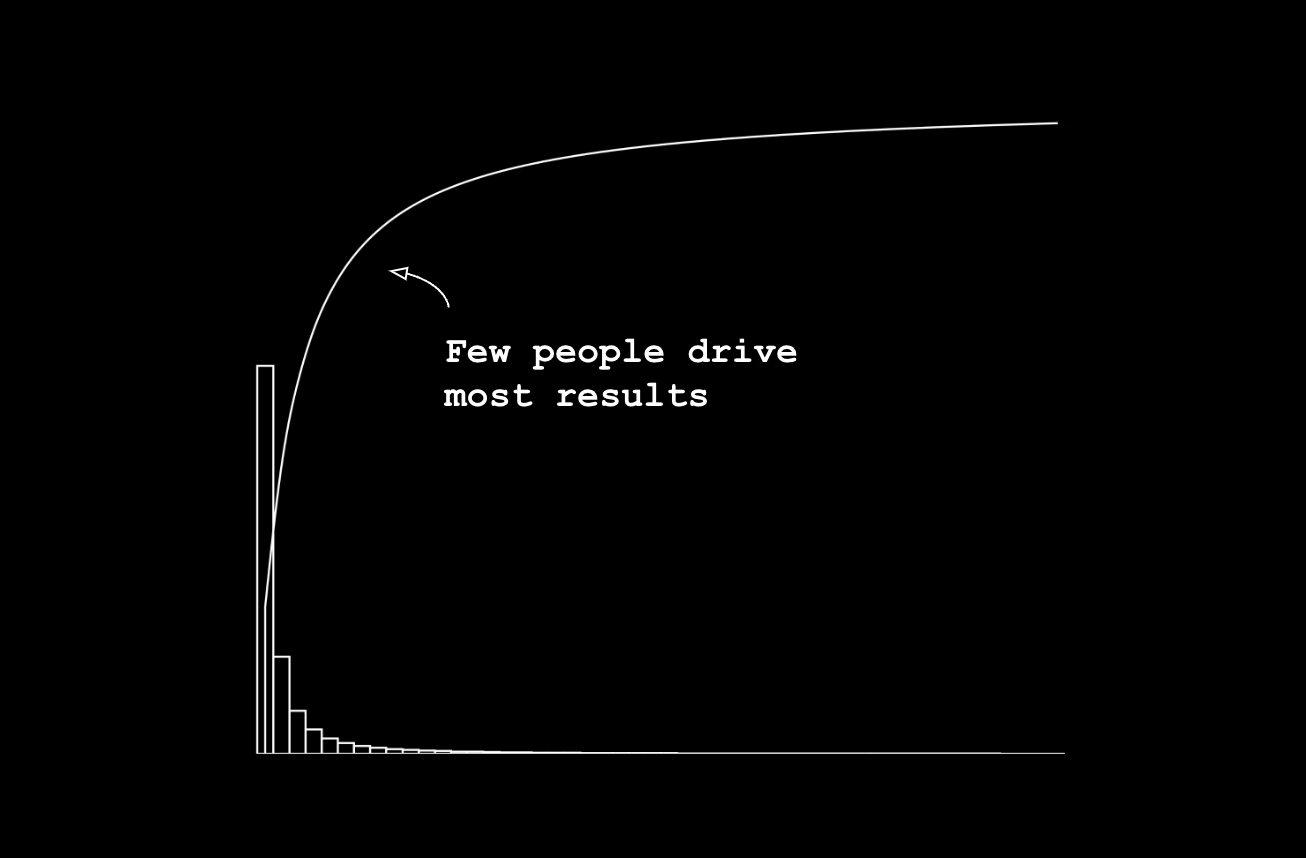 Pointing back to our thesis on our exponential world, the acceleration in speed of information not only makes it easier for talented folks to become more-so, it also makes it easier to find that talent. It’s a beautiful self-fulfilling prophecy. People that in another era might not have had the opportunity to learn enough to become exponential, now can – but in addition, they are free to share their work and have it be discovered. This is true across disciplines, from [sports](https://www.youtube.com/watch?v=dyof-qvpcM8), to [arts](https://www.youtube.com/watch?v=hvECZ_ZXGqs), to – naturally – [technology](https://en.wikipedia.org/wiki/George_Hotz). The whiz kids of the world that in another time might have been lost to History can now be found and nurtured.
Of course, this raw talent is typically not born out of thin air. Aside from continuous hard work, impactful individuals tend to point to a transformative moment or breakthrough that made them realize their potential and seek a broader community with whom to grow.
That leads us to Experiences.
## Exponential Experiences
What if that apple hadn’t fallen on Newton’s head (yes, it’s folklore – but the point stands). What if Steve Jobs hadn’t taken that [calligraphy class](https://youtu.be/UF8uR6Z6KLc?si=v15H03oQFmyTLfgp&t=228)? What would our world look like? There is no hiding that there is genius and hard work behind these stories, but there is also a component of right-place, right-time. Chance. At the heart of our mission is the belief that as a society, we cannot afford to leave progress to pure chance.
We believe that talent is evenly distributed, but unfortunately, opportunities are not. Less density of opportunities leaves less room for chance and serendipity. There is massive untapped potential in people that don’t know what they are capable of, because they don’t live in a world that can truly show them. Our core belief is that by exposing these individuals to transformative experiences and people—whether it's a cutting-edge research project, an impactful social initiative, or a groundbreaking startup—we can amplify their natural ability to drive outsized societal returns. In essence, we can 'change the growth rate' in their personal and professional growth curves, thereby accelerating the rate of progress for society as a whole. This is especially true early in the careers of these individuals. In this stage, it costs very little to generate this exposure, but the benefits can be immense.
So, how can we manufacture these experiences? How do we **engineer serendipity**?
That’s what the Exponential Fellowship is about. We want the future question to be “what if they hadn’t gone through the Exponential Fellowship”?
 The Exponential Fellowship
--------------------------
The thesis above explains our view of the coming world, and how its people and their experiences are the engine that will drive its accelerated progress. It could be summarized in three axioms:
1. **Technology →** Exponential growth and prosperity (𝑓(𝑥)) will come from nations’ capacity to leverage technology – largely software – to generate exponential outcomes. Those that do not leverage this reality will fall behind.
2. **People →** Exponential outcomes are driven by a few exponential people.
3. **Opportunities →** Talent is evenly distributed, but opportunities are not. The capacity to generate builders will be a function of the density of opportunities given (𝑎), and how early they are subjected to them (𝑥).
Holding these axioms to be true, then we must simply identify the right talent in places where opportunity density is low, and take them to places where opportunity density is high. This asymmetry in opportunities becomes a chance for nations to – for a very low cost – generate exponential value for their people. We then give them a community of like-minded individuals, and a network of experts to guide them on their paths.
Versions of this have existed for ages (e.g. graduate study scholarships), but these were focused on academic study. We want to focus on software and builders because we are [techno-optimists](https://a16z.com/the-techno-optimist-manifesto/).
So, what is the Exponential Fellowship?
The Exponential Fellowship is a program to get **Spanish technical whiz kids** through an **experience** at **top high-growth US startups**. The purpose is to inspire high-potential individuals, and put them on a path to build the next generation of exponential technologies through **opportunity**, **community** and **mentorship**.
The above statement can raise four questions: why Spain, why technical talent, why high-growth startups, and why in the US. The answers to most of these question lie in **focus.** Let’s run through them.
**Why Spain**
We believe that this model can be exported to any place in the world (at a national or local level) that is at a disadvantage when compared to communities that have been exporting software for decades. However, we need to start somewhere. The Exponential Fellowship is born from Spanish entrepreneurs, and so it’s where we have more leverage to start. We know where to look for that talent, and have built the institutional networks to help power this program.
**Why technical talent**
Similarly, this model can extend beyond pure technical talent. Builders come from all sorts of backgrounds. However, those that can code their ideas into reality (whether or not they’ve studied computer science) and build software are easier to place in these exponential experiences. It’s straightforward for them to have an outsized impact very early after joining an high-growth organization. It’s also easier for them – when the time comes – to launch their own startup, because they won’t necessarily have to look for their own technical co-founder.
**Why startups**
Because it’s where collisions happen. Startups are true representatives of the accelerationist concepts illustrated in our thesis. They reflect how chain reactions of innovation spread exponentially across ecosystems. Particularly interesting is the concept of startup _mafias_ – or alumni. For example, the [collisions generated at PayPal](https://alexandre.substack.com/p/-a-first-take-on-french-startup-mafias) gave birth to YouTube, Yelp, LinkedIn, Square, Palantir and so many others. The collision from those? The list is endless. [Europe](https://frenchtechmoscow.medium.com/a-first-take-on-french-startup-mafias-57256f90364a) and [Spain](https://endeavor.org/knowledge-center-events/thought-leadership/cabify-alumni/) also have their own examples.
In the 20th century, scholarships like Fulbright or Barrié and Rafael del Pino in Spain sent their brightest to the best Universities in the world because that’s where innovation happened. These epicenters are now high-growth startups.
**Why USA**
There is an inspirational, and a pragmatic component. Our ultimate goal is to inspire young talent, and they give the US and its startup scene somewhat of a legendary status. Opening the doors to the land of opportunity will inspire these future leaders to join the program. There are top startups everywhere in the world, but we want to focus our partnership and logistics efforts in a single country. The US is by far the place in the world with the highest density of opportunity.
We base our thesis in that focusing deeply in these categories will allow us to find the top 0.1% of early-career builders, and place them in the top experiences that will inspire them – with the right mentorship – to become the next generation of value creators.
If you want to learn more about who we are looking for and why, take a look at the document that outlines this
Beyond the Thesis above, this initiative is born from observing others. We take examples as proof that a new model of scholarship can be created to drive progress in the new Exponential Era.
In particular, the [Thiel Fellowship](https://thielfellowship.org/) has been a key piece of inspiration. While we don’t agree with Thiel’s drop-out philosophy (the reason why likely deserves its own short essay), we do agree that higher education is no longer the only path to develop high-potential leaders. In fact, we believe it is no longer the most efficient way. Here is an interesting piece of data: the Thiel Fellowship has had 271 recipients of $100,000. That’s a rough cost of ~$27 million. The enterprise value of startups out of Thiel Fellowship founders? Over $50 billion. It has returned it’s investment 1,850 times over. That’s without counting +$200B of market cap for Ethereum (also Thiel Fellowship founded), or the thousands of jobs it has directly and indirectly created. The exponential in action.
Interestingly, we also have in Spain a local source of inspiration. The program [Jóvenes con Futuro](https://twitter.com/JovenesFuturo) sent young Spaniards to Silicon Valley in the first half of the 2010s. Many have gone to hold strong positions in the world of tech in the US. One case stands out particularly, that of Miguel Carranza – founder of [RevenueCat](https://techcrunch.com/2021/05/27/revenuecat-raises-40m-series-b-for-its-in-app-subscription-platform/). The company he co-founded after his experience in Silicon Valley last raised a $40M round and employs over a dozen engineers in Spain. Just his effort was probably worth the entire Jóvenes con Futuro program.
Scholarship programs and Foundations all over the world – including in Spain – have the opportunity to launch and foster a new breed of fellowship adapted to a world where software is king. This is what we want to achieve at The Exponential Fellowship.
A Special Note from Us
----------------------
If you’ve gotten this far into the Manifesto, thank you! We wanted to take this section to get just a bit more personal. After all, there’s human people with human motivations behind the Exponential Fellowship. The truth is, who we are doesn’t matter. All you need to know is we find realization in seeing beautiful things being created – and more importantly, in enabling other people to create beautiful things.
We do this because we have been privileged – and quite frankly a bit lucky – to experience hypergrowth in our careers, driven by the boom of the European tech scene of the last 10 years. We’ve seen with our very own eyes the power of compounding relationships and learnings in our startup ecosystem. We’ve been part of 1st generations tech companies, and their spinoffs. We’ve seen what talent can do when it’s incubated in the right places.
Collectively, we have raised over $100M in venture funding, and have launched global products with global teams. But that’s not enough. We want to empower the next generation of founders.
We know there is more people out there that, like us, pursue a vision of creating for something greater than themselves. That’s what drives us personally to create this program and discover the next exponential people that will continue this exponential chain of value creation.
– Us
---
# Program details
Source: https://www.goexponential.org/program-details
In this page, you will find basic information about the program, including how it works, the bases to apply, and answers to frequently asked questions. Read carefully before applying.
## Basics
The Exponential Fellowship is a once-in-a-lifetime opportunity to learn to build in some of the most exciting startups in the US. It is meant to accelerate the careers of young builders and generate future founders for the Spanish ecosystem.
The Exponential Fellowship is built on three pillars: **opportunity**, **mentorship**, and **community**. The goal of the program is to provide high-agency builders with a bridge to the US to accelerate their careers, and a support network and community to explore opportunities to make the most of the experience.
---
## What You Get
Selected Fellows will get to work in New York or the San Francisco Bay Area startups and immerse in the local startup scene. The duration of the Fellowship is limited by the J1 visa:
- 18 months for Fellows with 1 year since graduation, and 1 year of work experience.
- 12 months for recent (≤1 year) graduates of BSc, MSc, or PhD.
The J1 visa is specifically created for immigrants to receive training and learn from US experiences. Fellows may pursue other visa programs (e.g., H1B or O1) during the stay, but must leave the country before visa expiration if they do not attain another visa.
Fellows will also participate in exclusive events, get access to world-class entrepreneurs and investors, and become part of a community of like-minded builders.
---
## What We Cover
The Fellowship covers all expenses to be able to land in the United States. We process and pay for your J1 visa, health insurance, and flights to your destination. We help you gather and complete all required paperwork.
All startups participating in the program pay at a minimum entry-level salaries for Software Engineers in the area. This can range from $80,000 to $150,000. This is to ensure every Fellow can cover living expenses (and then some), regardless of their current economic position.
---
## Requirements
### Must Haves
The following are hard requirements to participate in the Fellowship. Under no circumstances may these requirements be unmet:
- You must have completed or be on your last year of a BSc, MSc, or PhD in a Technical field (e.g., Mathematics, Physics, Computer Science, Engineering…).
- You must have demonstrable building experience (e.g., a side-project, OSS collaboration, a busy GitHub/GitLab, some work experience, etc.).
- You must have a C1 or above level of English.
- You must have strong ties to Spain; born in Spain, parents born in Spain, or have spent at least the last 5 years in Spain (exceptions apply to students currently studying abroad).
- You must be willing to travel and live in the United States for a minimum of 12 months.
- You were born in 1998 or later. This is a slightly soft requirement; we could make exceptions for specific cases.
---
### Recommended Skills
The Exponential Fellowship is a highly competitive process. We recommend meeting most if not all of the following nice-to-haves:
- You have a track record of excellence (e.g., 90th percentile in class, regional or national awards, math or physics Olympiad participations, successful side projects, etc.).
- You have experience working in Software Engineering teams, whether in a work environment or in a community or OSS project.
- You have experience working in startups.
- You have demonstrable knowledge of how startups work and are an insider of the startup scene (e.g., you know who Paul Graham is, youʼve read Peter Thiel, you have a CTO idol, you know the top VC funds in Spain, etc.).
---
### Don't Apply If
Before applying, please make sure that your personal values and motivations are aligned with the Fellowship. Do not apply if:
- You do not wish to pursue a career in entrepreneurship.
- You do not want to live and work in the United States, or must travel back frequently to Spain.
- You have not read our [Manifesto](/manifesto).
---
## Selection Process
The selection process works on a rolling basis to adapt to the hiring needs of participating startups and the work cycles of potential Fellows. The total process can take between 3 and 12 months, although the first 3 steps are typically performed within 2–6 weeks.
Even if the cohorts are rolling, we strongly recommend applying as early as possible. The longer you are in the candidate database, the higher your odds of attaining a Fellowship.
---
### Phase I: Application
The first step in the process is a simple form to get to know who you are and what you have built. It should be filled out thoughtfully and should take between 20–40 minutes to complete. Be concise, but help us understand your achievements and motivations. Weʼre looking for signals of high technical capacity, some knowledge of the startup ecosystem, and strong personal motivations.
Due to the volume of applications, most submissions do not receive direct feedback. Strong applications are typically reached out to within 1–2 weeks.
**Success rate:** 20%
---
### Phase II: Personal Interviews
If your application is up to standard, you will be invited to 1 or 2, 30-minute personal interviews. The goal of these interviews is understanding your story in-depth and your right-to-win in the US ecosystem. Weʼre looking to find signals that you will fare well in the startups you will work in and make the most of the local startup scene.
Some candidates in this phase will be eliminated, others will be deferred to a future cohort (with the possibility of placement in a top Spanish startup), and others will move forward.
**Success rate:** 15%
---
### Phase III: Startup Matching
If signals are strong, you will be placed in a candidate database. Youʼll be given a page to share your profile with the startups participating in the Fellowship. You will be guided by the Fellowship team to create the best profile possible.
The candidate database is shared with the participating startups, which then decide who to interview. This phase is the longest one, as not all companies have hiring needs at all times. We are working hard to increase the startup pipeline to reduce waiting periods here.
The candidate then goes through the standard interview process for a given startup – it s̓ now in your hands! Those candidates that receive a Fellowship offer from a participating startup will become Exponential Fellows.
---
### Phase IV: Welcome, Fellow
Congrats! Youʼll be assigned to an Exponential Fellowship cohort and be processed for your J1 visa. Once selected, the process to be able to land in the United States takes 1–2 months.
---
# Who we look for.
Source: https://www.goexponential.org/who-we-look-for
Exponential is its people. Our Community, Launchpad, and Fellowship programs are made for – and composed of – a specific type of person.
In our Manifesto youʼll see that our initial approach is a focused one. While talent is everywhere, weʼll focus on **technical talent from Spain**. This means that the ability to code is a requirement.
We hope to be able to open it up for other backgrounds in the coming classes. Here is how we view exponential talent.
## Exponential Talent
We look for courageous builders with a will to serve, because we believe that's what it takes to create exponential organizations.
What does it take for someone to be exponential? What defines a true innovator? These are some very hard questions, and their answers will vary dramatically depending on who is reading this. For us, it's a matter of culture. Culture defines the behaviors, practices and beliefs that a person holds dear. Culture defines what drives a person. That culture is born out of their values.
Our selection process is therefore values-based.
## Values
Values show us how people will behave when no one is looking. How they will react in the face of hardship. An important distinction is that weʼre not looking just at people's potential to create value. Weʼre looking for exponential people with a heart – that are driven by their will to give back. Here are our values, and their rationale.
### Service
Service mindset is the value that enables the magic to happen and sits above the others. Great people tend to do great things in service of something larger than themselves. Their family, the problems they love, their God (or gods in lower case). Service is about humility, positive intent and doing the right thing. People with this mindset are coachable, build positive culture, and create healthy teams. They generate trust, which leads to impact.
### Courage
Courage is about boldness and dreaming big. It's a value that drives action and hard work. It's the fuel to the rocketship. People who hold this value generate dynamic organizations where feedback is demanded and given with radical candor. They can solve conflicts effectively and take calculated but necessary risks, critical to create exponential returns.
### Craft
This is a special one. Builder attitude. It's the value of the curious. They are pragmatic tinkerers, get things figured out and done - and they do it to fulfill their own pride. In other words, they are intrinsically self-motivated, they build for the love of building, without needing any incentive on top. People who hold this value create organizations that ship fast, continuously learn, and – frankly – that just have a lot of fun. They tend to be good at multiple disciplines, caring not just for technical aspects, but also keeping business, product and user dimensions front and center.
The beauty of these values is how they work together.
Service and courage without craft creates talkers, not doers. Courage and craft without service makes for lone wolves. Craft and service without courage renders submission. This is why each one is important.
Finally, it is not a coincidence that these values are the same weʼve used to create successful teams. It doesnʼt mean that these values are perfect – you can create exponential organizations with a more cutthroat or “shark” culture – but that's just not who we are.
## Observations
Now that we understand these values, the question ahead is how to observe and identify them. How do we find the talent that believes in what we believe? The short answer is we donʼt know, and the truth is that – at times – we will fail. But the framework to find proxies for them is as follows:
### Track record of excellence
It's a proxy for hard work, intellectual prowess and bias to action. A strong work ethic is nearly a guarantee in those with an academic or athletic (amongst others) success. It's a reflection of courage and ability.
### Demonstrable building experience
If a person has built something in the past – a passion project, a blog, an app –, it's more than likely that they will continue to build throughout their lives. It helps identify builder attitude, team building skills, and intellectual curiosity.
### Visible care for others
Honestly, this is the hardest one to see on paper. However, it's not so hard to read in interviews because it can be asked. People that care tend to be honest and humble. They possess the service mindset we are looking for.
The process is open to everyone, under strict criteria.